One of the more difficult things in life is to admit to having been wrong.
Not just a little bit wrong, but stridently so.
I had the privilege of having dinner yesterday with a distinguished doctor; a Catholic of unimpeachable ethics, and a good chap to boot.
We discussed heart transplants, and he told me that I was wrong.
Given that I have blogged (and as I say, stridently) on this, on more than one occasion, it is important that I correct this error.
He is very clear that brain stem death is an acceptable and reliable indication of death; that the heart may continue to beat beyond death if a patient is on a ventilator, and that the removal of that beating heart is ethically quite acceptable. Indeed, if it is done to save another life, it is clearly a moral good.
Once the brain stem is dead (which is verifiable) there is no prospect of any recovery. The brain is irreversibly damaged, and consciousness is forever gone. This is most common in people with severe trauma to the head (eg as a result of road traffic accidents) and whilst their heart may be kept going by extraordinary technical means, they really are dead.
I raised the query about the need to anaesthetise before removing the beating heart (which I have to confess is the bit that really brings me up short) and he said that is done as there may still be nerve activity from (eg) the spinal cord that might cause movements, which could impede the operation (as well as needlessly distress the medical staff).
The other instances that have caused concern have been where doctors have failed in their duty of diagnosis etc. Clearly that is very wrong, but it does not call into question the practice of heart (or liver etc) transplants per se.
I am now going back over my old posts about this, adding an update, directing people to this post, to minimise any further risk of misleading people.
UPDATE
I should make it clear that we were discussing the situation in the UK. I understand that different and more dangerous ideas and practices may be prevalent elsewhere, including the US.
Showing posts with label Ben gets it wrong. Show all posts
Showing posts with label Ben gets it wrong. Show all posts
Sunday, 9 February 2014


Friday, 13 September 2013
Misleading my readers
A few days ago, I tweeted that Autumn was here, as there was mist in the valley, and the swallows had left.
I accompanied it with a rather beautiful picture of the valley filled with mist: and not a swallow in sight.
However, since then, I have noticed that, although there are no swallows or house martins dipping around the house, as they have been doing all summer, there are large numbers of them just up the hill on the lane to the common.

They are gathering on the phone wires, clearly chatting about the onset of September, and the need to fly South soon. But they haven't gone.

Which raises interesting questions in my mind. Is that just chance? Is it that our swallows have moved up the hill, and if so is that preparatory to flying south? Will it give them a better start? Or is it that our swallows have gone, but their hardier cousins, who have been living at a (slightly) higher altitude all summer, are still around?
Are there any ornithologists out there able to enlighten me?
(I see there is published research on this, but my curiosity doesn't extend to the £30 price tag to read it...)
I accompanied it with a rather beautiful picture of the valley filled with mist: and not a swallow in sight.
However, since then, I have noticed that, although there are no swallows or house martins dipping around the house, as they have been doing all summer, there are large numbers of them just up the hill on the lane to the common.

Taken this morning, about 50 metres higher than our house.
They are gathering on the phone wires, clearly chatting about the onset of September, and the need to fly South soon. But they haven't gone.

Taken this morning, another few metres higher
Which raises interesting questions in my mind. Is that just chance? Is it that our swallows have moved up the hill, and if so is that preparatory to flying south? Will it give them a better start? Or is it that our swallows have gone, but their hardier cousins, who have been living at a (slightly) higher altitude all summer, are still around?
Are there any ornithologists out there able to enlighten me?
(I see there is published research on this, but my curiosity doesn't extend to the £30 price tag to read it...)
Friday, 14 June 2013
A Chip off the Old Block
In fairness to Ant (see last post) I should put it on the record why I nearly failed to get my degree (a very mediocre second - fortunately they weren't divided into 2:1 and 2:2 at my university back in my days).
Anyway, the reason I nearly failed to get mine was that I had miscopied the examination timetable and was on the point of leaving my digs with Mrs T (Miss Perdita, as she was then) for a trip into town, when the college porter phoned to ask where I was. I was desperate to rush to the exam immediately, but he insisted in giving me a pep talk: however hopeless I might feel, it was always better to turn up, there might be a quesiton I could attempt and so on...
So I managed to get him off the phone and then into sub-fusc and gown, onto the bike, and to the Examination Schools at breakneck speed. Fortunately it was a translation paper (for which they always gave too much time, in my experience) rather than a literature paper; so I strolled in nonchalantly as though I'd planned to come in 15 minutes late for this one.
Which probably tells you all you need to know about my academic career.
Anyway, the reason I nearly failed to get mine was that I had miscopied the examination timetable and was on the point of leaving my digs with Mrs T (Miss Perdita, as she was then) for a trip into town, when the college porter phoned to ask where I was. I was desperate to rush to the exam immediately, but he insisted in giving me a pep talk: however hopeless I might feel, it was always better to turn up, there might be a quesiton I could attempt and so on...
So I managed to get him off the phone and then into sub-fusc and gown, onto the bike, and to the Examination Schools at breakneck speed. Fortunately it was a translation paper (for which they always gave too much time, in my experience) rather than a literature paper; so I strolled in nonchalantly as though I'd planned to come in 15 minutes late for this one.
Which probably tells you all you need to know about my academic career.
Wednesday, 5 December 2012
Misjudging CTA
In my last post, I said some harsh things about CTA.
However, since then I have read this account of their meeting in October. I was astonished to read that they feel the bishops have a 'lack of appreciation of how the imposition of the new liturgy has disappointed laity.’ I feel exactly the same way myself. The imposition of the new liturgy, replacing the time-hallowed Immemorial Mass was certainly disappointing to many of the laity, but I was surprised to hear that voiced in this context.
However, since then I have read this account of their meeting in October. I was astonished to read that they feel the bishops have a 'lack of appreciation of how the imposition of the new liturgy has disappointed laity.’ I feel exactly the same way myself. The imposition of the new liturgy, replacing the time-hallowed Immemorial Mass was certainly disappointing to many of the laity, but I was surprised to hear that voiced in this context.
Another promising quotation was: ‘it’s all very well to talk about Vatican II - but how many Catholics today really know what it said?’
Again, my sentiments exactly!
Some people seem to think that Vatican II authorised, or even ordered, all sorts of things which it did not. Reading the documents and implementing them (Latin as the primary language of Worship, Chant having pride of place in liturgical music, for starters) would certainly be my idea of progressive action.
Someone else, apparently, talked about ‘opening up spaces where people can be listened to with respect and gentleness.’ It’s called the confessional, and in our diocese the bishop makes sure it is opened up additionally in Advent and Lent, which is a great initiative.
Such respect is given in the confessional, of course, that a good priest won’t patronise you by pretending your sins are not sins, but will respect your status as a pilgrim and fortify you for the journey by helping you address your weaknesses, and giving you God’s grace and forgiveness in the Sacrament.
So was I misjudging CTA?
Perhaps not. For on reflection, I think the first comment may have been a jibe thrown at the new, improved translation of the Mass; the second I suspect is conceived in ignorance of the very teaching of the Council it professes to admire; and the third is less interested in the Church telling him where he’s wrong than in him telling the Church where She is wrong.
As you were.
Sunday, 2 December 2012
Crushed
I was boasting on Twitter the other day about my superior home-made advent wreath. I went up to the attic today to fetch it (reflecting that if I was G K Chesterton, I would write a great essay about the other things I happened to see in the attic) and when I got it out of the bag in which it had been stored, I found that it was crushed.
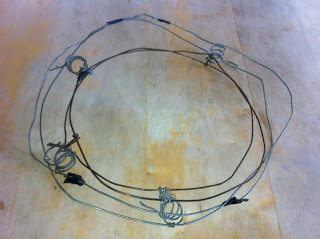

(I wonder if Anna squashed it deliberately! Unworthy thought...)
So, as the headline suggests, I am feeling crushed....

To my chagrin, Anna was delighted. I don't think she ever liked it, but it has done something like 20 years sterling service.
I am sorry that there are no extant photos (or at least none I can find) of it in use - though of course the whole point was that in use, you only saw a circle of holly with candles emerging.
However, I suspect Anna has long been hoping for its demise, as she had an immediate solution up her sleeve.

(I wonder if Anna squashed it deliberately! Unworthy thought...)
So, as the headline suggests, I am feeling crushed....
Sunday, 13 May 2012
Gratias ago
I wish to thank Marc Puckett for pointing out an error in last night's Latin lesson - and for doing it tactfully and privately! I had copied a previous paragraph to use the structure (1st, 2nd person etc) and forgotten to change the translation, giving the impression that ago means I praise (etc) It has now been corrected. If you printed off last night's lesson, please note the amendment!
Saturday, 4 February 2012
On Marital Rape
First things first: in stating that ‘from a Catholic perspective, marital rape is quite simply an oxymoron; it is not possible,’ I was wrong.
This post is my thinking-out-loud about why I was wrong, and where I was right in my thinking. As always, I claim no infallibility: indeed I invite correction.
This post is my thinking-out-loud about why I was wrong, and where I was right in my thinking. As always, I claim no infallibility: indeed I invite correction.
One of the things I like about blogging is that if I display my ignorance, misunderstandings and prejudices publicly, eventually somebody with something useful to say may turn up and put me right, or at least put me on the right track.
Since I first posted on this, here, I have had a number of comments offered, some in private and some in the public domain. Few were helpful, as only a few actually addressed what I had written. Claiming that I was condoning rape, and denouncing me as an extremist, whether publicly or privately, didn’t really address the issues (satisfying though that may have been).
I am somewhat intrigued by those who, having misunderstood, thought it essential to email me privately and put me right (sometimes in somewhat condemnatory terms) but who, when I wrote back clarifying what I had and hadn’t meant by my post, and again inviting correction, declined to respond. ‘What’s all that about?’ I ask myself...
He makes a number of points. His first point I have no issue with, other than that it misses the point I was making (unless, of course, I have missed the point he was making...). I was not talking about civil marriages; I limited myself specifically, I thought, to a Catholic understanding of Christian marriage.
His second point was more germane:
Secondly, I do not think that the ius in corpus must include 24/7 availability. Rotal jurisprudence has held that the limitation of the right to sexual acts at certain times e.g. illness does not vitiate matrimonial consent. Even if sexual refusal in a certain case is sinful, that does not necessarily legitimise forceful attempts to redress the situation. Theft is wrong; that does not mean we can always use violence to get our property back.
The point about rotal jurisprudence is clearly a very important one, and suggests that I was taking too simplistic approach to the notion of irrevocable consent. I always agreed, of course, that recourse to force is not legitimate in this area (as I hope I made clear); my only question was whether ‘rape’ was the right label for that particular wrong.
So the first half of this paragraph is the most relevant to my thinking.
Somebody else, who prefers to remain anonymous, also emailed me:
Lifted from the SSPX US website:There can, however, be good reasons that excuse a husband or wife from rendering this marriage debt, such as adultery of the other spouse, or unreasonable demands (e.g. frequency, intoxication) or grave danger to health or life (e.g. by the possible communication of infectious diseases), or a husband who refuses to perform his duty of supporting his family (Jone, Moral Theology, pp. 557 & 558). There can also be special circumstances that reduce the culpability of refusing the marriage debt, so that it is only a venial sin, for example "if the petitioner will readily renounce his right, or if rendering it is only briefly postponed, or when the use of the marriage right is frequent and its refusal is only rare."
I quote this, not because I endorse the SSPX particularly (for me, full, visible, unconditional communion with Peter is pretty foundational...) but because even their most vehement critic (which I am not) would be unlikely to see them as inclining to liberalism in moral issues. Again, what it shows is that my understanding of irrevocable consent was too simplistic.
The most important, in many ways, was Vincent's third point.
Thirdly, there is the jurisprudence and theology surrounding ratum sed non consummatum marriages. This refers to the power of the Roman Pontiff alone to dissolve the bond of a sacramental but non-consummated marriage, whereas a marriage ratum et consummatum is dissoluble by no human power; only death. For many years the question was debated whether or not sexual intercourse with violence or against protests (i.e. rape, by most people’s understanding of the word) could qualify as the consummation needed to make a marriage extrinsically indissoluble. The 1983 Code of Canon Law settled this question by requiring the act to be performed humano modo i.e. with the voluntary consent of both parties. This interpretation of humano modo is supported by the December 20th 1986 circular letter of the Congregation for the Sacraments, which is itself pretty similar to a responsum ad dubium of the Holy Office of February 2nd 1949. The point of the diversion is this: the Church makes provision for for the possibility of non-consensual sexual intercourse as early as the wedding night. Furthermore, it judges that such non-consensual intercourse is apparently not the object of the consent to ius in corpus exchanged in marriage.
That seems to me to be pretty conclusive: which is why I have realised that I was wrong in my earlier assertion.
He then added:
Finally, trying a different tack, let’s look at the Catechism of the Catholic Church. 2356: “Rape is the forcible violation of the sexual intimacy of another person. It does injury to justice and charity. Rape deeply wounds the respect, freedom, and physical and moral integrity to which every person has a right. It causes grave damage that can mark the victim for life. It is always an intrinsically evil act.” or “Stuprum ingressum indicat per vim, cum violentia, in sexualem alicuius personae intimitatem...” Note that the definition is based on force or violence, not on ‘consent’. It seems to me that your argument against the existence of marital rape is based on a legalistic application of ‘presumed consent’, when consent – presumed or actual - is not part of the definition of rape.
Game, set and match! Not only was I wrong on the application of irrevocable consent, I was also wrong in my definition of rape.
I would add a few further thoughts:
One is that it is interesting, both in this case and in the case of Stephen Green, which kicked all this off, how many people were quick to leap to the knee-jerk ‘How could you possibly be so evil as to condone rape?’ position.
The second is that I maintain that the way in which couples are prepared for marriage gives insufficient clarity to the nature of the vows. On the one had, my misunderstanding was clearly never addressed when we were instructed some 30 years ago (and to all those who in private correspondence have taken a prurient interest in my marriage, I can now reveal that this misunderstanding has never had any incarnation in our marital relations). On the other hand, I can see nothing in current marriage preparation programmes that addresses this with any clarity.
The third is that I still stand by the understanding that irrevocable gift of the self, with particular reference to the body, is at the heart of Christian marriage. That is the ius in corpus referred to above. I do not warm to the expression ‘marriage debt’ for all the obvious reasons, but at least it had clarity. I can see why it has been discarded over time, but feel we have failed to replace it adequately.
Finally (and this has been a long post - if anyone has read this far, I’m impressed - but like so much blogging, the principal beneficiary is the writer...), finally, as I said before I interrupted myself, I have some unease about defining rape only on the basis of force, and not consent - but maybe here I am again confusing civic and canon law. In civic law it is already hard to get convictions for rape: requiring the proof of force, not just the lack of consent, would, I fear, make it harder.
Incidentally, Vincent’s valediction, was a good example of how to sign off when you have basically been telling someone he’s got the wrong end of the stick: he found some points of agreement and assumed my intention, even if not my thinking, was good.
All that said, I think you are correct to note the increasing trend to decouple marriage from sexual intercourse, which we see has resulted in the current epidemic of contraception, abortion, homosexual unions et cetera. Keep up the good work!
We could do with more such clear, non-confrontational, and fundamentally friendly fraternal correction on the Catholic blogosphere, and I would like to thank Vincent both for putting me right, and for his approach.
Subscribe to:
Posts (Atom)


.jpg)


